
Working Capital Gap: MSME Funding Challenges Explained

𝐘𝐨𝐮'𝐯𝐞 𝐖𝐨𝐧 𝐭𝐡𝐞 𝐎𝐫𝐝𝐞𝐫. 𝐍𝐨𝐰 𝐖𝐡𝐨 𝐅𝐮𝐧𝐝𝐬 𝐈𝐭?𝐓𝐡𝐞 𝐰𝐨𝐫𝐤𝐢𝐧𝐠 𝐜𝐚𝐩𝐢𝐭𝐚𝐥 𝐠𝐚𝐩 𝐧𝐨𝐛𝐨𝐝𝐲 𝐦𝐨𝐝𝐞𝐥𝐬 𝐛𝐞𝐟𝐨𝐫𝐞 𝐛𝐢𝐝𝐝𝐢𝐧𝐠
19, 2026 · Sushant Vasishta
Most businesses that sell to government and large enterprise clients are staffed to win work, but only a few are staffed to fund what comes after. The gap between those two things kills more MSMEs and contractors than a bad bid price. The day you win is the day the money goes out Picture a scenario - a contractor with a small order book wins a ₹20 crore order with an eighteen-month execution period. It is the best day for the business with congratulations all around. The order book has doubled, and people are murmuring about the next big bid.
Now let's follow the money. Before a single rupee is billed, the cash starts to leave. The mobilization advance is a modest percentage and is released only against a bank guarantee (BG) of equal value, i.e. a loan dressed as an inflow. The performance guarantee (PG) has to be lodged before the work starts; and the bank holds margin money against it in a fixed deposit for the life of the contract. Even though that cash belongs to the company, it is locked out and out of its reach for years. Locked out PG & BG creates a false sense of security for the owner: an illusion of a financial cushion. Meanwhile the contract execution has to be funded from day one.
Materials, labour, plant, subcontractors- each, every month, out of the contractor's own pocket. The first bill is released at the end of month one. It is measured, certified, queried, and paid somewhere between sixty and a hundred and twenty days later, depending on the authority. So, there is typically no cash inflow for at least a quarter after the contract award. CRISIL Ratings put the average debtor cycle for diversified EPC contractors at about 75 days in November2026 and flagged working capital pressure rising wherever government fund releases run late.
Retention money and deposits sit on top of that, keeping gross current assets elevated for the life of the contract. If we put this together, the issue becomes clear. The contractor funds materials, labour and plant for the first few months before a single rupee arrives. The better the order, the bigger the float, and bigger the problem for the contractor. This is not a sign of a badly run business. It is how the contract is designed to work. The problem is that almost no contractor puts a number on it before they sign the LOA.
The number you put in the tender already carries an assumption about how the work gets funded- how much of it you can carry, for how long, and on whose money. Most bidders price the work, win it, and discover the assumption afterwards.
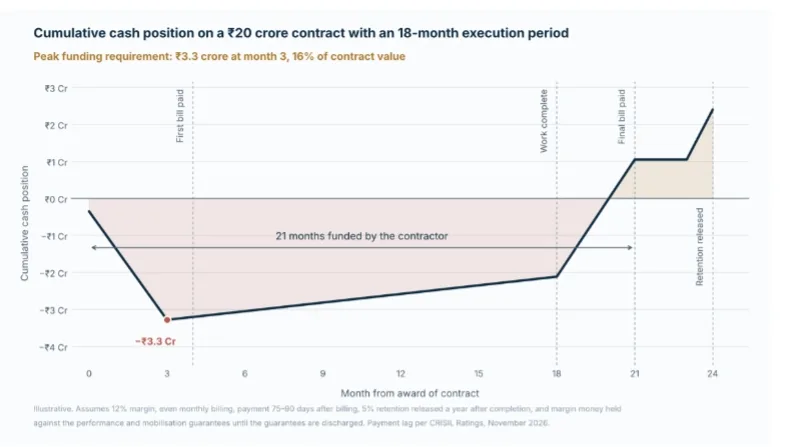
The above figure displays what the bank account looks like on a ₹20 crore contract built over 18 months. The line shows how much of its own money the business is carrying at each point. It stays below zero until the final bill is paid in month 21. At the worst point, the contractor is funding ₹3.3 crore himself, which is about a sixth of the contract value. The bank limit does not follow the order book; the obvious answer is to go to the bank.
The obvious answer, though, runs into a structural problem. Working capital limits are assessed against what the business did last year. Audited turnover, last year's debtors, last year's inventory cycle. The order books you just won do not appear in that assessment, because as far as the credit file is concerned it has not happened yet. So, the business that has just doubled its order book is operating on a limit sized for half of its network load. Enhancement is possible but is slower than the payment cycle it is meant to fund. By the time the enhanced limit is sanctioned, the crunch it was meant to solve has either passed or has already done its damage.
There is a second problem underneath this. A contractor who stretches creditors to bridge the gap or runs the cash credit account permanently at the limit, is building exactly the profile that makes the next credit enhancement harder.
The behavior the shortage of cash forces is the behavior the next credit assessment penalizes. This is not a fringe problem. The Deloitte's State of Financial Services in India report in June 2026, put India's MSME credit gap at roughly ₹25 lakh crore as of March 2025 and found that only 14% of MSME can access formal credit. Measured against the sector's contribution to GDP, Deloitte suggests the unmet requirement could exceed ₹50 lakh crore.
The receivable does not rescue you either; the next obvious answer is to discount the bill. You are holding a certified claim against a government body, with not much credit risk. Surely that is the easiest receivable in the market to finance. It is actually one of the most difficult. I spent a fair part of the past few months asking invoice discounting providers the same question, and the answers were consistent enough to be worth reporting. Much of the market will not touch running account bills where the payer is a government authority.
Not because they expect to lose the money, but because they cannot predict when it arrives and there is no counterparty they can meaningfully chase. A financier can price default risk, although an indefinite delay with no escalation path is a different thing altogether. So, the contractor ends up in an odd position. His receivables are amongst the safest in the economy but is also amongst the least financeable. The security that would reassure any credit committee is the security the working capital market is least willing to lend against.
The numbers bear this out. Suppliers have filed 2,56,892 delayed-payment applications on the government's MSME Samadhaan portal since it opened in 2017, and about ₹2,406 crore remained outstanding from central public sector enterprises as of February 2026. The reality of the newer online dispute resolution portal is starker: of the 14,814 cases registered, only 26 had been resolved as of March 2026.Why nobody sees it coming Every serious bidder builds a financial model before the bid goes in. I have built several this year, for highway wayside amenities on DBOT and for O&M concessions, where the bid is a single number and there is not second chance at it. Bid too high and you lose the tender.
Bid too low and you win something you cannot afford to deliver. The models answer one question well: does the contract make a margin at this price? Revenue, cost build-up, escalation, IRR, payback. They rarely answer the second question: can the business survive the months between doing the work and being paid for it?
Those are different questions and they have different answers. A contract can be comfortably profitable across its life and still need more cash in month four than the company has ever held in its account at one time. The model says yes, but the bank balance says no. The reason this surface is late is structural. Margin is visible at bid stage because the tender forces you to calculate it, whereas cash is visible at execution stage, because that is when it runs out. By the time anyone looks at the cash curve, the options narrow to whatever can be arranged in a hurry- which is always the most expensive version of whatever is available at the time.
Five things to do before you bid, not after Model the cash curve next to the margin. Same spreadsheet, with an additional block assuming the payment at the authority's real record rather than its stated terms. The number you want is the deepest the account goes before it turns. That is the facility you actually need.
Count what the guarantees lock up. Margin money on the performance and mobilization guarantees, plus retention on every bill. None of it is lost, all of it is unavailable, and it sits idle for years. Open the limit conversation while the order book is growing. A banker who has watched the pipeline build for two quarters reads the same numbers very differently from one approached in the month payments go late. Find out early who will lend against the receivable.
It varies by lender, by authority and by contract structure, and takes weeks to establish. If left until month four, it costs whatever the one lender who says yes decides to charge. Price the financing into the bid. Interest, guarantee commission and the cost of carrying late collections all belong in the bid number. Leave them out and the margin your model reports is not the margin you will earn.
Two problems, one team The businesses that get into trouble here are rarely the ones bidding badly. More often they are the ones bidding well and growing faster than their balance sheet can carry, which from the outside looks identical to success right up until the cash crunch hits. Winning the order and funding it are two different problems. Most organizations are staffed, incentivized and congratulated for the first one.
The second one tends to belong to nobody in particular until the month the cash flow issues surface. If you are bidding for work in the next two quarters, the useful question is not whether you can win it. It is whether you have put a number on what winning will cost you in cash, and who you would call if that number turned out to be larger than you thought.
Author bio-Sushant Vasishta is the founder of Aarohan Advisory, which works with infrastructure and manufacturing businesses on two things: preparing bids for government and public-sector contracts, and raising the debt to deliver them
Share this article
Send it to a colleague or post it to your network.